
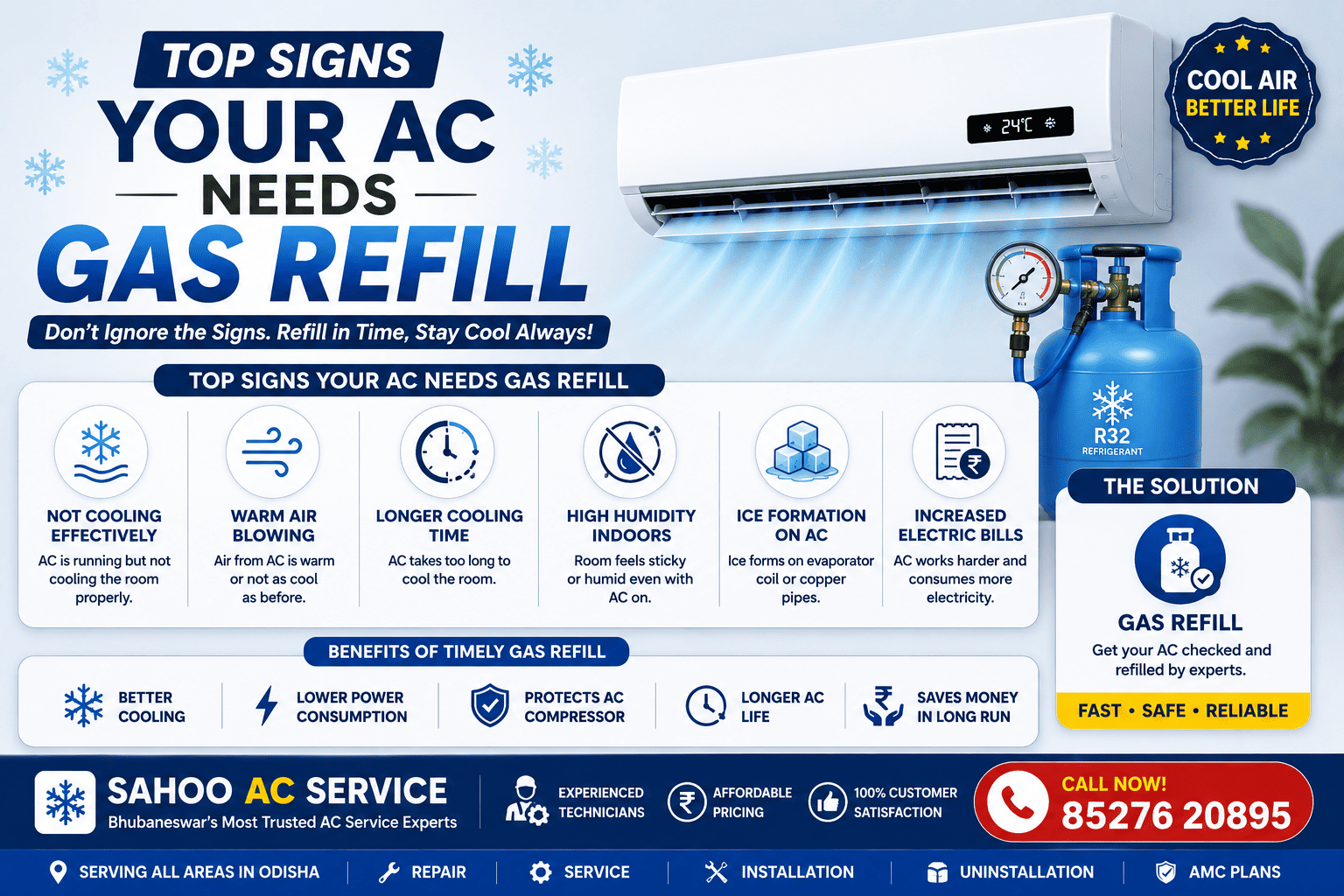
When your air conditioner stops cooling properly, most people immediately assume that the AC needs gas refilling. While low refrigerant is one of the most common reasons behind poor cooling, it is not always the only cause.
However, refrigerant gas plays a critical role in the cooling process. Without the proper gas level, your AC cannot absorb heat efficiently, making it work harder while delivering weaker cooling performance.
Many homeowners and office owners ignore the early warning signs of low refrigerant. Unfortunately, this can lead to higher electricity bills, increased wear on the compressor, and expensive repairs in the future.
In this guide, we’ll discuss the most common signs that indicate your AC may need professional inspection and gas refilling.
What Does AC Gas Actually Do?
Before understanding the warning signs, it’s important to know the role of refrigerant gas inside an air conditioner.
The refrigerant continuously circulates through the AC system, absorbing heat from indoor air and releasing it outside.
This process is what produces cool air.
If the gas level drops because of leakage or system damage, the cooling cycle becomes inefficient, causing noticeable performance issues.
A healthy AC system does not consume refrigerant under normal conditions. If gas is low, there is usually an underlying leak that should be identified and repaired.
1. Your AC Is Running but Cooling Is Weak
One of the earliest signs of low refrigerant is reduced cooling performance.
The AC may appear to work normally:
- Fan runs properly
- Display functions correctly
- No major error messages
But the room takes much longer to cool.
Many people notice that the AC is running continuously while indoor temperature remains uncomfortable.
If your air conditioner was cooling perfectly a few weeks ago but suddenly struggles to cool the room, low refrigerant may be the reason.
2. AC Takes Too Long to Cool the Room
Every AC is designed to cool a specific room size within a certain period.
When refrigerant levels become low:
- Heat removal becomes slower
- Cooling cycle efficiency decreases
- Compressor runs longer
As a result, you may notice:
- Room temperature drops very slowly
- AC remains on for extended periods
- Desired temperature is difficult to achieve
This is a common complaint during summer in Bhubaneswar when AC units operate continuously.
3. Higher Electricity Bills Without Increased Usage
Have you noticed your electricity bill increasing even though your AC usage remains the same?
Low refrigerant often forces the compressor to work harder and longer.
Because the system struggles to cool efficiently, it consumes more power than usual.
Many homeowners first discover an AC issue when they receive an unexpectedly high electricity bill.
If your monthly power consumption has increased significantly, your cooling system should be inspected.
4. Ice Formation on Indoor Coils
Many people are surprised to learn that low refrigerant can actually cause ice to form inside an air conditioner.
When refrigerant pressure drops:
- Coil temperature becomes excessively cold
- Moisture freezes on the evaporator coils
- Ice begins accumulating around the unit
Common signs include:
- Visible ice buildup
- Frozen copper pipes
- Reduced airflow
- Water leakage after ice melts
This issue should never be ignored because it can eventually damage internal components.
5. Water Leakage from Indoor Unit
Water dripping from an indoor unit is often linked to drainage issues, but low refrigerant can also contribute.
Here’s how:
- Low refrigerant causes coil freezing.
- Ice accumulates over time.
- Ice melts when the AC stops or temperature changes.
- Excess water overwhelms the drainage system.
The result is visible leakage from the indoor unit.
If leakage appears alongside weak cooling, refrigerant levels should be checked.
6. Hissing or Bubbling Sounds
Refrigerant travels through sealed copper lines.
When a leak develops, you may hear unusual sounds such as:
- Hissing noises
- Bubbling sounds
- Soft whistling near copper pipes
These noises often indicate refrigerant escaping from the system.
Even a small leak can gradually reduce cooling performance.
Professional leak detection should be performed immediately to prevent further gas loss.
7. AC Runs Continuously Without Reaching Set Temperature
Your AC should cycle on and off periodically.
If it runs continuously without achieving the desired temperature:
- Cooling efficiency may be reduced
- Refrigerant levels may be insufficient
- Heat transfer process may be compromised
Continuous operation not only affects comfort but also increases stress on the compressor.
Over time, this can lead to expensive repairs.
8. Warm Air Instead of Cool Air
This is one of the most obvious warning signs.
You may notice:
- Airflow feels normal
- Fan speed remains unchanged
- Temperature feels warm or neutral
When refrigerant levels become critically low, the system can no longer absorb enough heat from indoor air.
As a result, cool air disappears despite the AC appearing operational.
9. Compressor Becomes Overworked
The compressor is the most expensive component inside most air conditioners.
Low refrigerant forces the compressor to work much harder than normal.
Consequences include:
- Excessive heat generation
- Increased energy consumption
- Reduced lifespan
- Risk of compressor failure
Replacing a compressor can be significantly more expensive than addressing a refrigerant leak early.
10. Reduced Comfort During Peak Summer
Many AC owners first notice refrigerant problems during extremely hot days.
During mild weather, the system may appear functional.
However, when temperatures rise:
- Cooling struggles become obvious
- Room comfort decreases
- AC performance drops noticeably
This happens because the system lacks sufficient refrigerant to handle higher cooling demands.
Why AC Gas Doesn’t Normally Get Consumed
One common misconception is that AC gas gets “used up” over time.
In reality, refrigerant circulates in a closed system.
If gas levels are low, it usually means:
- A leak exists
- A connection has loosened
- A copper pipe has been damaged
Simply refilling gas without identifying the leak often results in the same problem returning later.
A proper inspection should always accompany gas refilling.
Can You Continue Using an AC with Low Gas?
Technically yes, but it’s not recommended.
Operating an AC with insufficient refrigerant can cause:
- Higher electricity bills
- Poor cooling
- Compressor damage
- Reduced equipment lifespan
The longer the issue continues, the greater the repair cost may become.
How Often Does an AC Need Gas Refill?
A properly functioning AC system may run for many years without requiring gas refilling.
Gas refill is needed only when:
- Refrigerant leakage occurs
- Copper piping is damaged
- Service connections develop leaks
Regular maintenance helps identify these issues early.
How to Prevent Refrigerant Problems
While some leaks are unavoidable, preventive maintenance reduces risk significantly.
Schedule Regular Servicing
Routine inspections help identify small leaks before they worsen.
Clean Components Regularly
Proper airflow reduces system stress.
Monitor Cooling Performance
Changes in cooling should never be ignored.
Address Small Problems Early
Minor refrigerant leaks are easier and less expensive to repair.
When Should You Call a Professional?
You should arrange professional inspection if you notice:
- Weak cooling
- Ice formation
- Water leakage
- Hissing sounds
- Rising electricity bills
- Continuous compressor operation
Early diagnosis helps avoid costly repairs and restores cooling performance faster.
Final Thoughts
Low refrigerant is one of the most common reasons behind poor cooling performance, especially during peak summer conditions.
If you notice weak cooling, higher electricity bills, frozen coils, water leakage, or unusual noises, your system may require professional inspection and gas refilling.
The most important thing to remember is that refrigerant does not simply disappear. A proper diagnosis should always identify the root cause before refilling gas.
By addressing refrigerant issues early, you can improve cooling efficiency, reduce energy costs, protect your compressor, and enjoy uninterrupted comfort throughout the year.