
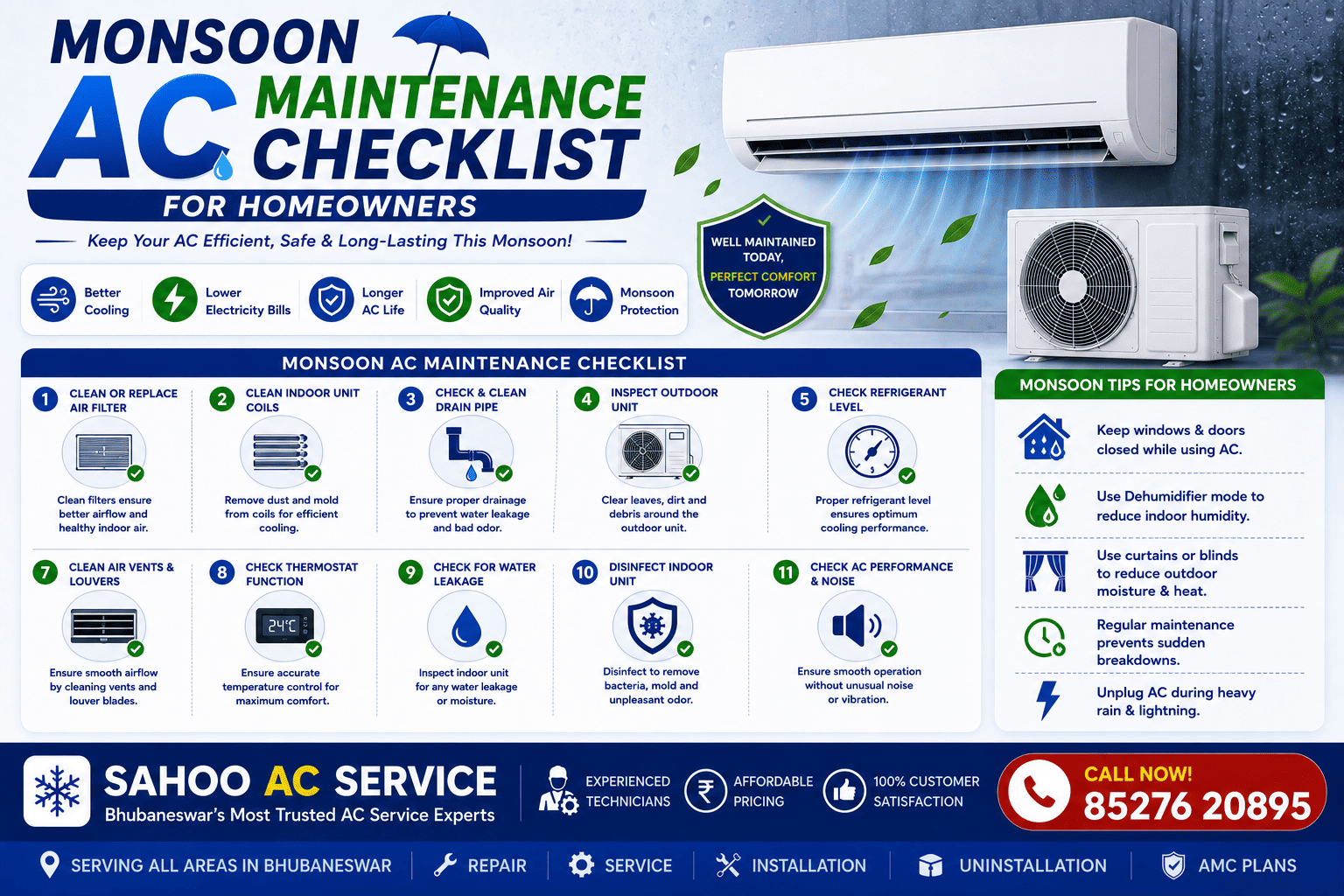
Most homeowners believe air conditioners need the most attention during summer. Once the rainy season arrives and temperatures start dropping, many people assume their AC no longer requires maintenance.
Unfortunately, that’s a mistake.
In fact, monsoon can create a completely different set of problems for air conditioners.
High humidity, moisture buildup, drainage issues, mold growth, water leakage, and reduced airflow are all common during the rainy season. If your AC isn’t maintained properly, you may experience poor cooling, bad odors, increased electricity bills, and unexpected breakdowns.
The good news is that a few preventive maintenance steps can keep your air conditioner running efficiently throughout the monsoon season.
This complete Monsoon AC Maintenance checklist will help homeowners protect their AC, improve indoor comfort, and avoid expensive repairs.
Why Monsoon Is Challenging for Air Conditioners
During summer, the primary job of an AC is to remove heat.
During monsoon, the challenge changes.
Your AC must now deal with:
- High humidity levels
- Excess moisture in the air
- Drainage system pressure
- Mold and fungus growth
- Reduced airflow due to moisture
Even when outdoor temperatures are lower, indoor discomfort can remain high because of humidity.
This is why AC maintenance becomes extremely important during the rainy season.
Checklist Item #1: Clean or Replace Air Filters
Air filters are the first line of defense against dust, pollen, and airborne particles.
During monsoon:
- Moisture combines with dust
- Filters clog faster
- Airflow becomes restricted
A dirty filter forces the AC to work harder and reduces cooling efficiency.
What You Should Do
✔ Clean washable filters every 15–30 days
✔ Replace damaged filters
✔ Check for mold buildup
Clean filters improve airflow and help control humidity more effectively.
Checklist Item #2: Inspect the Drain Pipe
Water leakage is one of the most common monsoon AC complaints.
The drainage system removes condensation generated during cooling.
When the drain pipe becomes blocked:
- Water backs up
- Indoor leakage occurs
- Wall damage becomes possible
Maintenance Tip
Check whether water flows freely through the drain pipe.
If drainage appears slow, schedule professional cleaning immediately.
Checklist Item #3: Use Dry Mode More Often
Many homeowners never use the Dry Mode feature available in modern air conditioners.
However, during monsoon, Dry Mode can be more useful than normal cooling mode.
Benefits of Dry Mode
✔ Removes excess humidity
✔ Improves comfort
✔ Reduces stickiness
✔ Consumes less electricity
On moderately cool rainy days, Dry Mode often provides better comfort than aggressive cooling.
Checklist Item #4: Clean the Outdoor Unit
The outdoor unit works continuously to release heat.
During monsoon, it may collect:
- Leaves
- Mud
- Dust
- Debris
Blocked airflow reduces cooling efficiency.
What to Check
✔ Remove leaves and dirt
✔ Ensure proper airflow
✔ Inspect for standing water
✔ Keep surrounding area clean
A clean outdoor unit improves overall system performance.
Checklist Item #5: Check for Unusual Odors
Monsoon humidity creates ideal conditions for mold growth.
If you notice:
- Musty smells
- Damp odors
- Fungal smells
your AC may require deep cleaning.
These odors often indicate contamination inside:
- Filters
- Cooling coils
- Drain trays
- Blower components
Professional cleaning helps eliminate odor-causing buildup.
Checklist Item #6: Verify Cooling Performance
Many homeowners focus only on temperature.
However, comfort during monsoon depends heavily on humidity control.
Ask yourself:
- Is the room still feeling sticky?
- Does cooling feel weaker?
- Is airflow reduced?
These symptoms may indicate maintenance is required.
Early detection helps prevent larger issues later.
Checklist Item #7: Inspect for Water Leakage
Even small water leaks should never be ignored.
Common signs include:
- Wet walls
- Water dripping from indoor unit
- Damp flooring
- Water stains
Ignoring leakage can result in:
- Paint damage
- Mold growth
- Electrical risks
Address drainage issues immediately.
Checklist Item #8: Listen for Unusual Noises
Humidity and moisture sometimes affect moving components.
Pay attention to:
- Buzzing sounds
- Rattling noises
- Grinding sounds
- Vibrations
These sounds often indicate developing mechanical problems.
The earlier they’re identified, the easier they are to fix.
Checklist Item #9: Check AC Temperature Settings
Many people continue using summer settings during monsoon.
This often increases electricity consumption unnecessarily.
Recommended Temperature
24°C to 26°C
This range provides:
✔ Comfortable cooling
✔ Better humidity control
✔ Improved efficiency
✔ Lower electricity bills
Avoid setting temperatures extremely low.
Checklist Item #10: Schedule Professional Servicing
The most important step on this checklist is professional maintenance.
A trained technician can inspect areas homeowners cannot easily access.
Professional servicing typically includes:
✔ Filter cleaning
✔ Coil cleaning
✔ Drain pipe inspection
✔ Refrigerant pressure check
✔ Electrical inspection
✔ Performance testing
Routine servicing helps identify hidden problems before they become expensive repairs.
Common Monsoon AC Problems Homeowners Face
Many rainy-season issues occur because maintenance is delayed.
The most common problems include:
Water Leakage
Usually caused by blocked drainage systems.
Bad Smells
Often linked to mold and moisture buildup.
Weak Cooling
Dirty filters and restricted airflow are common causes.
High Electricity Bills
Poor maintenance reduces efficiency.
Ice Formation
Can occur due to airflow restrictions or refrigerant issues.
Understanding these problems helps homeowners respond quickly.
How Often Should You Service Your AC During Monsoon?
For most homes:
Once Before Monsoon
and
Once During Monsoon
is usually sufficient.
However, heavy AC users may benefit from additional inspections.
Homes with:
- Pets
- Dust exposure
- Continuous AC usage
often require more frequent maintenance.
Benefits of Following a Monsoon Maintenance Checklist
Homeowners who follow preventive maintenance practices enjoy several advantages.
Better Cooling
Clean systems cool more efficiently.
Improved Air Quality
Reduced dust and mold buildup.
Lower Electricity Bills
Efficient operation consumes less power.
Fewer Breakdowns
Small issues are detected early.
Longer AC Lifespan
Reduced wear and tear on components.
Monsoon Maintenance Mistakes to Avoid
Avoid these common errors:
❌ Ignoring water leakage
❌ Skipping filter cleaning
❌ Never using Dry Mode
❌ Delaying professional servicing
❌ Blocking outdoor unit airflow
❌ Running AC at extremely low temperatures
These mistakes often lead to expensive repairs later.
Need Professional AC Maintenance Service?
If your AC is showing signs of:
- Water leakage
- Weak cooling
- Bad smell
- High electricity bills
- Excess humidity
our technicians can help.
Our Services Include
✔ AC Maintenance
✔ Deep Cleaning
✔ Drain Pipe Cleaning
✔ AC Inspection
✔ Cooling Performance Check
✔ Gas Pressure Testing
📞 Call Now: +91 85276 20895
🌐 Book Online:
https://sahooacservice.com/contact-us/
Final Thoughts
Monsoon weather may reduce outdoor temperatures, but it creates new challenges for air conditioners. High humidity, drainage issues, moisture buildup, and mold growth can all affect cooling performance if maintenance is ignored.
By following this Monsoon AC Maintenance Checklist, homeowners can improve comfort, reduce electricity bills, prevent breakdowns, and extend the lifespan of their air conditioning system.
A small amount of preventive care today can save significant repair costs tomorrow.
Our Service Areas
AC Repair in Bhubaneswar
Patia | Rasulgarh | Khandagiri | Old Town | Chandrasekharpur | Jaydev Vihar | Nayapalli | Saheed Nagar | Acharya Vihar | Vani Vihar
AC Repair in Cuttack
CDA Sector 6, 7, 9, 10 | Badambadi | Buxi Bazaar | College Square | Link Road | Tulsipur | Choudwar
AC Repair in Kendrapara
Kendrapara Town | Baniamal | Patkura | Marshaghai | Aul | Derabish | Rajkanika | Mahakalapada | Rajnagar | Garadpur | Pattamundai | Nikirai | Batipada | Narasinghpur | Tinimuhani